

India has steadily expanded its global trade partnerships to strengthen economic growth, create jobs, and enhance its global standing.
After signing six Free Trade Agreements in the last five years, the latest being with Oman this month, India and New Zealand have just concluded negotiations for a forward-looking FTA, marking a historic milestone in bilateral economic relations.
The Agreement delivers unprecedented duty-free access for Indian exports to New Zealand while safeguarding India’s sensitive sectors, strengthening economic resilience, and promoting inclusive growth aligned with India’s national priorities. India and New Zealand announced negotiations for a Free Trade Agreement (FTA) In March 2025.
Following several rounds of negotiations, the India-New Zealand FTA was concluded in December 2025, becoming one of India’s fastest-concluded FTAs. This FTA enhances market access and tariff preferences for Indian exports to New Zealand, while serving as a gateway to the wider Oceania and Pacific Island markets.
Salient Features
The FTA eliminates duty on 100% of Indian Exports
- A USD 20 billion investment commitment over 15 years strengthens long-term economic and strategic cooperation.
- Through Agricultural Productivity Partnership, the FTA collaborates with farmers to boost productivity and integrate them in the global value chains.
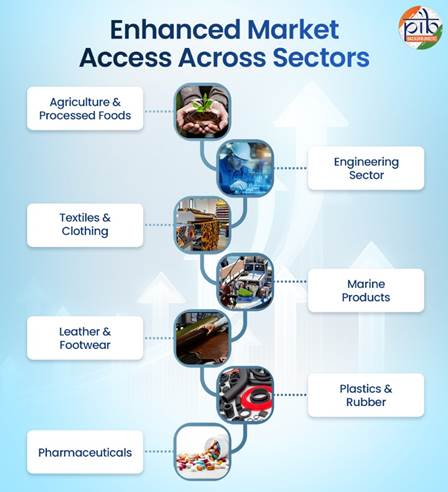
- The FTA boosts MSMEs and Jobs through Zero-duty access for labour-intensive sectors including textiles, apparel, leather, footwear, gems & jewellery, engineering goods and processed foods.
- India has offered market access in 70.03% of the tariff lines while keeping 29.97 % tariff lines in exclusion. Immediate Elimination (EIF) on 30%, Rest is phased.
- Certain products are kept in exclusion such as Dairy (milk, cream, whey, yoghurt, cheese etc.), animal products (other than sheep meat), vegetable products (onions, chana, peas, corn, almonds etc.), sugar, artificial honey, Animal, vegetable or microbial fats and oils, Arms and Ammunition, Gems and Jewellery, Copper and Articles (Cathodes, Cartridges, Rods, Bars, Coils etc.), Aluminium and articles thereof (Ingots, billets, wire bars) among others.
- 30.00% of tariff lines will have immediate duty elimination, covering wood, wool, sheep meat, leather-raw hides etc
- 35.60% of tariffs are subject to phased elimination over 3, 5, 7, and 10 years, including petroleum oil, malt extract, vegetable oils, and selected electrical and mechanical machinery, peptones etc.
- 4.37% of products face tariff reductions, such as wine, pharmaceutical drugs, polymers, aluminium, iron and steel articles etc
- 0.06% fall under tariff rate quotas, including honey, apples, kiwi fruit, and albumins including milk albumin.
Opportunities for India (Gains)
- New Zealand’s market access offer covers immediate elimination of duties (zero duty) on 100% of tariff lines of New Zealand (8,284 tariff lines), from Entry into Force.
- New Zealand maintained tariffs around 10% in around 450 lines of key Indian exports in products
- Labour intensive sectors like textiles and clothing, leather and footwear;
- Emerging and advanced engineering sectors like transport/auto, pharmaceuticals, plastic & rubber, electrical & electronic machinery, mechanical machinery, chemicals and;
- Agri Products like fruits and vegetables, coffee, spices, cereals, processed foods
- Gains from import to support domestic industries: wooden logs, coking coal, waste and scrap of ferrous, non-ferrous metals
Over and above these, the bilateral trade agreement also has Foreign Direct Investment, mobility for high end jobs and higher education facilities. India New Zealand Trade also has services export from India.
By mid of 2026 this agreement may be implemented.
For further insights read
https://www.pib.gov.in/PressNoteDetails.aspx?id=156654&NoteId=156654&ModuleId=3®=3&lang=1