


India – Oman Comprehensive Economic Cooperative Agreement (FTA)
India and Oman share a long-standing and trusted relationship rooted in centuries of maritime trade and cultural exchange across the Indian Ocean. Oman holds strategic importance for India due to its location near the Strait of Hormuz, making it a key gateway to the Gulf, Africa, and Europe. With strong economic ties, a large Indian diaspora, and growing trade complementarities, Oman has emerged as a reliable partner for India. The signing of the India–Oman Comprehensive Economic Partnership Agreement (CEPA) marks a significant step in deepening this partnership by unlocking new trade, investment, and export opportunities for Indian businesses.
Economically, Oman is a high-potential trade partner for India, offering strong demand for Indian exports such as textiles, engineering goods, pharmaceuticals, food products, chemicals, and services. The large Indian diaspora in Oman—one of the biggest expatriate communities in the country—further strengthens commercial linkages, labour mobility, and cultural ties.
India’s competitive countries like China and Turkey do not have such a FTA with Oman yet.
We give below a clear sector-wise outline of which exporters of India would benefit the most under the India–Oman CEPA, once it is implemented.
This is focused on Indian exporters and the products that will gain maximum tariff advantage.
- Textiles & Apparel (Biggest Winner)
Why it benefits most:
- Oman has large demand for clothing, fabrics, and home textiles
- Under CEPA, tariffs on most textile products are reduced to zero
- India has strong manufacturing capacity & competitive pricing
2. Engineering Goods & Auto Components
Why it benefits:
- Oman is investing in infrastructure, logistics, industrial parks, and energy projects
- Engineering goods are a major import category for Oman
3. Pharmaceuticals & Medical Devices
Why it benefits:
- Oman relies heavily on imports for medicines and medical equipment
- CEPA provides tariff relief and better market access
4. Chemicals & Plastics
Why it benefits:
- Strong industrial demand in Oman
- Lower tariffs help India compete against Middle East and European suppliers
5. Agriculture & Processed Foods
Why it benefits:
- Oman has high demand for Indian food products
- CEPA reduces tariff barriers, making Indian foods more competitive
6. Gems & Jewellery
Why it benefits:
- Oman has a strong market for gold jewellery and luxury products
- CEPA reduces duty burden on finished jewellery and gemstones
7. Leather & Footwear
Why it benefits:
- Oman imports large volumes of leather goods and shoes
- India is a global leader in leather manufacturing
8. Automotive & Vehicles (Passenger + Commercial)
Why it benefits:
- Oman imports vehicles for consumer and commercial use
- CEPA reduces tariffs on key auto categories
Sector wise summary of Tariff and Key Products
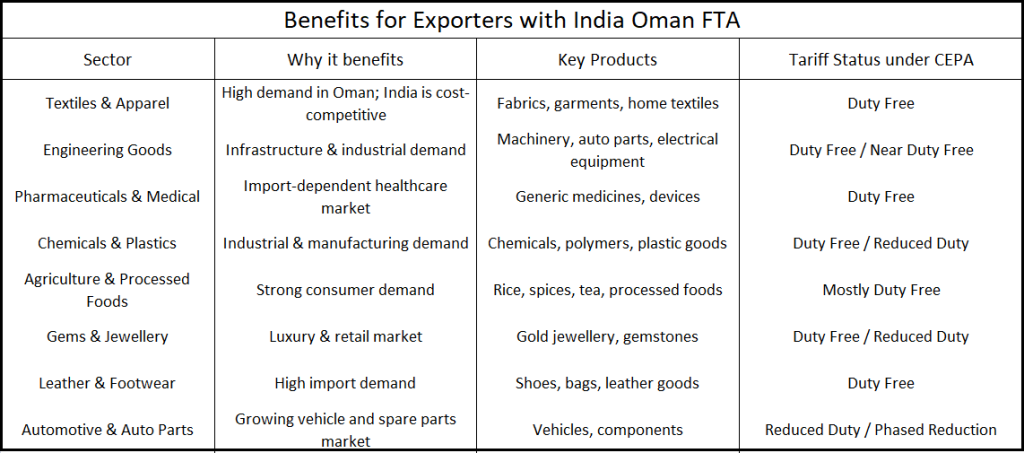
CEPA strengthens India’s competitiveness against other exporting nations and supports the country’s ambition to emerge as a reliable global manufacturing and services hub. In this context, CEPA with Oman serves as a model for India’s future trade partnerships—focused not just on volumes, but on strategic market access and long-term economic alignment.