
If you are an Indian exporter dealing in food, agricultural or animal-based products, you may come across the requirement for a Health Inspection Certificate or Health Certificate before exporting your goods.
Health inspection is important because importing countries want assurance that products entering their markets are safe for human consumption, free from harmful contamination and compliant with their health and hygiene standards.
However, health inspection is not mandatory for every export product in India. The requirement depends on the product, its HS Code, the applicable Indian export regulations and the destination country’s rules.
Health inspection is an examination and testing process carried out by an authorised government agency to confirm that an export product meets prescribed health, hygiene, safety and quality standards.
It may involve:
- Physical inspection of the product.
- Laboratory testing for bacteria, chemicals, pesticides or other contaminants.
- Checking manufacturing and processing hygiene.
- Verifying storage, handling and packaging conditions.
- Checking compliance with the importing country’s health requirements.
After successful inspection, the competent authority may issue a Health Certificate or another prescribed export certificate.
In India, the Export Inspection Council (EIC) and its Export Inspection Agencies (EIAs) play an important role in export quality inspection and certification.
- For Which Products Is Health Inspection Mandatory in India?
The Export Inspection Council (EIC), under the Ministry of Commerce and Industry, covers notified commodities under the Export (Quality Control and Inspection) Act, 1963.
The following products are included in its notified commodity list:
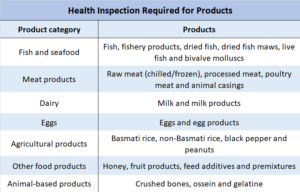
These commodities are subject to applicable quality-control and inspection requirements. The exact certification and inspection procedure varies by product and export destination.
Important distinction: Not every food product requires the same Health Certificate. For example:
- Fish and fishery products require quality control and inspection before export and a Certificate for Export (CFE).
- Meat products require consignment-wise health certification and prescribed testing.
- Other notified products may follow establishment approval, food safety management certification or consignment inspection requirements.
- Which Government Agency Issues Health Certificates?
The main authorities include:
- EIC (Export Inspection Council): Responsible for export inspection and certification of notified commodities.
- EIA (Export Inspection Agency): Conducts inspection, testing coordination and certification through its regional offices.
- APEDA: Provides export-related registration and certification services for scheduled agricultural and processed food products. Its Meat.Net system facilitates health certificates for meat exports.
- State Animal Husbandry Department: Issues health certificates for meat consignments through authorized veterinary officials.
The certificate-issuing authority depends on the product and the applicable export scheme.
- How Can an Exporter Apply for a Health Inspection in India?
Here is the general procedure:
Step 1: Identify the Requirement
- Check your product’s HS Code.
- Check whether it is covered under EIC’s notified commodities.
- Confirm the destination country’s health and certification requirements.
Step 2: Register with the Relevant Authority
- Visit the official EIC website: EIC India.
- Obtain the required exporter or establishment registration, depending on the applicable scheme.
- Register for online certification services and obtain login credentials.
Step 3: Submit the Application
Log in to the relevant portal and submit the application for inspection or a Health Certificate.
Documents may include:
- Importer’s details and destination country.
- Commercial invoice and packing list.
- Product details and HS Code.
- Manufacturing or processing establishment details.
- Laboratory test reports.
- Other product-specific documents.
Step 4: Physical Inspection and Laboratory Testing
The EIA or other competent authority may:
- Inspect the product and storage conditions.
- Collect samples.
- Conduct laboratory testing.
- Verify compliance with applicable standards.
Step 5: Obtain the Health Certificate
Once the required checks are successfully completed, the competent authority issues the applicable certificate. Obtain it before shipment wherever required.
Conclusion
Health Inspection and Health Certification are important steps in ensuring the safety and quality of Indian export products. For exporters dealing in seafood, meat, dairy, agricultural and other regulated products, understanding these requirements is essential to avoid shipment delays, rejection or compliance issues.
Before exporting, always check whether your product requires mandatory inspection, laboratory testing, establishment approval or a Health Certificate. The requirements may differ depending on the HS Code, product category and importing country.
Remember: A successful export shipment starts with product compliance, proper inspection and the right certification.
Frequently Asked Questions (FAQs)
- Is Health Inspection mandatory for all export products from India?
No. Health Inspection is not mandatory for every export product. It depends on the product category, applicable Indian export regulations and the importing country’s requirements.
- Which authority conducts Health Inspection in India?
The Export Inspection Council (EIC) and its Export Inspection Agencies (EIAs) conduct inspection and certification for applicable notified commodities. Other competent authorities may handle specific products, such as meat and plant-based products.
- What is the difference between a Health Inspection and a Health Certificate?
Health Inspection is the process of examining and testing a product for safety and quality. A Health Certificate is an official document issued by an authorised authority confirming compliance with applicable health requirements.
- How can an Indian exporter apply for a Health Certificate?
Exporters can visit the EIC website (www.eicindia.gov.in) and check the applicable certification procedure. For meat exports, APEDA provides the Meat.Net online system through which registered processing establishments can apply for consignment-wise Health Certificates.
- Can a merchant exporter apply for a Health Certificate without owning a manufacturing unit?
Yes, in certain cases. A merchant exporter can export products sourced from an approved or registered processing establishment, subject to the applicable product-specific rules and certification procedure. For example, fishery product exports require certification through the prescribed approved-establishment system.