India is a major exporter of food products, including rice, spices, fruits, vegetables, seafood, processed foods, dairy products and meat. However, exporting food products from India involves more than finding an international buyer and arranging shipment.
An Indian food exporter must comply with various government regulations, registrations, food safety standards and product-specific certification requirements.
Whether you are a merchant exporter, manufacturer exporter or a new exporter, understanding the mandatory licenses and registrations required to export food products from India is essential.
This guide explains the important registrations, certificates, their purpose and where Indian exporters can obtain them.
- Importer-Exporter Code (IEC)
Purpose: IEC is the basic identification number required to export goods from India. It is issued by the Directorate General of Foreign Trade (DGFT).
- Mandatory: Yes, for most commercial exports of goods.
- Who needs it? Merchant exporters and manufacturer exporters.
- Where to apply: DGFT – Official Website.
- Important: IEC details must be updated or confirmed every year between April and June.
- FSSAI Central License
Purpose: The Food Safety and Standards Authority of India (FSSAI) regulates food safety and hygiene in India. Food exporters must obtain the applicable FSSAI license.
- Mandatory: Yes, for food exporters.
- Who needs it? Merchant exporters and manufacturer exporters dealing in food products.
- Where to apply: FoSCoS – FSSAI Portal.
- Important: The exporter category is specifically listed under Central License eligibility, without a turnover or capacity limit.
Note: FSSAI does not require a separate NOC for exporting food products. An FSSAI license is required.
- GST Registration
Purpose: GST registration enables exporters to undertake applicable GST compliances and claim export-related zero-rated benefits.
- Mandatory: Generally required for commercial goods exporters.
- Where to apply: GST Portal.
- Important: Exports are treated as zero-rated supplies under GST. Eligible registered exporters can export under a Letter of Undertaking (LUT) without payment of IGST or pay IGST and claim a refund, subject to applicable rules.
- Registration-cum-Membership Certificate (RCMC)
Purpose: RCMC establishes an exporter’s registration with the relevant Export Promotion Council or Commodity Board.
- Mandatory: Depends on the product and purpose. It is required where prescribed for the relevant authorization, benefit or scheme under the Foreign Trade Policy.
- Where to apply: DGFT’s e-RCMC portal through the relevant Export Promotion Council or Commodity Board.
For example, exporters of APEDA-scheduled products can apply for APEDA e-RCMC after obtaining IEC.
- APEDA Registration
Purpose: The Agricultural and Processed Food Products Export Development Authority (APEDA) promotes and regulates the export of specified agricultural and processed food products.
Its scheduled products include:
- Fruits, vegetables and their products.
- Meat, poultry and dairy products.
- Cereals and cereal products.
- Basmati rice and other scheduled rice products.
- Honey, jaggery and sugar products.
- Pickles, papads and chutneys.
- Cashew nuts and their products.
- Mandatory: Exporters of APEDA-scheduled products must register with APEDA.
- Where to apply: APEDA Official Website or through DGFT’s e-RCMC portal.
- Important: Obtain IEC before applying for APEDA registration.
- Spices Board Registration (CRES)
Purpose: The Certificate of Registration as Exporter of Spices (CRES) is required for businesses exporting spices and spice products.
Examples include turmeric, cumin, coriander, black pepper, chilli, cardamom and spice powders.
- Mandatory: Yes, for spice exporters.
- Where to apply: Spices Board of India.
- Important: Both merchant exporters and manufacturer exporters must obtain the applicable registration.
- MPEDA Registration for Seafood Exporters
Purpose: The Marine Products Export Development Authority (MPEDA) regulates and promotes India’s marine product exports.
It covers products such as frozen fish, shrimp, prawns, squid and other seafood.
- Mandatory: Yes, for marine product exporters, subject to prescribed exemptions.
- Where to apply: MPEDA Official Website.
- Important: Both merchant exporters and manufacturer exporters must obtain exporter registration. Processing establishments are also subject to applicable approval requirements.
- Health Certificate / Certificate for Export (CFE)
Purpose: This certificate confirms that applicable health, hygiene and safety requirements have been met.
It is particularly relevant for seafood, meat and other regulated animal-based food products.
- Mandatory: For products and destinations where prescribed.
- Where to apply: Export Inspection Council (EIC), Export Inspection Agencies (EIAs), approved establishments or the relevant competent veterinary authority, depending on the product.
- Official website: Export Inspection Council of India.
Important: Fish and fishery product consignments require prescribed quality inspection and a Certificate for Export (CFE) before shipment.
- Phytosanitary Certificate
Purpose: A Phytosanitary Certificate confirms that specified plants and plant products meet the importing country’s plant health requirements and are free from regulated pests.
Examples include:
- Fresh fruits and vegetables.
- Seeds and planting materials.
- Certain grains and pulses.
- Other regulated plant products.
- Mandatory: When required by the importing country’s plant quarantine regulations.
- Where to apply: Directorate of Plant Protection, Quarantine and Storage (DPPQS), through the relevant Plant Quarantine Station.
- Important: The requirement depends on the product, destination and applicable pest-risk conditions.
- Certificate of Origin (COO)
Purpose: A Certificate of Origin confirms the country in which the exported goods originate.
It is useful when buyers or importing-country customs authorities require proof of origin. It is also important when claiming preferential customs duty under a Free Trade Agreement (FTA).
- Mandatory: When required by the buyer, importing country or applicable trade agreement.
- Where to apply: Authorized agencies, including designated chambers of commerce and other authorized issuing bodies. Preferential certificates are issued through the prescribed authorized agencies.
- Important: The rules of origin must be satisfied to claim preferential duty benefits.
- Organic Certification (NPOP)
Purpose: Organic certification verifies that food products have been produced, processed, packed and handled according to recognized organic standards.
Examples include organic rice, spices, pulses, fruits, vegetables and processed foods.
- Mandatory: For products exported as organic under India’s applicable export certification system.
- Where to apply: APEDA-accredited certification bodies under the National Programme for Organic Production (NPOP).
- Official website: APEDA Organic Certification Portal.
- Commodity-Specific Registrations and Licenses
Certain food products require additional registrations with their respective Commodity Boards.
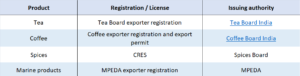
For example, coffee exporters must register with the Coffee Board and obtain the prescribed export permit and Certificate of Origin for shipments.
- Other Important Product-Specific Approvals
Apart from the registrations mentioned above, exporters may need additional approvals depending on the product and destination country.
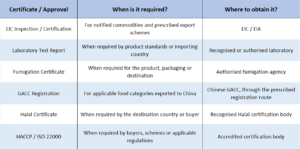
Note: These approvals are not universally mandatory for every food export. Check the importing country’s requirements before arranging certification.
- Basic Business and Customs Registrations
In addition to food-specific licenses, exporters should complete the following business and customs formalities:
- PAN: Required for business and tax identification. Obtain it from the Income Tax Department.
- Bank Account: Maintain a current account in the business’s name with an authorized dealer bank.
- AD Code Registration: Register the bank’s Authorized Dealer Code with the relevant Customs/ICEGATE system for export transactions.
- GST: Goods and Service Tax – Register & get a GST number
- ICEGATE Registration: Register on the Indian Customs Electronic Gateway for applicable customs filing and services.
- Shipping Bill: File the shipping bill electronically through the customs system for export clearance.
These are important export-operating requirements, although they are not food safety certificates.
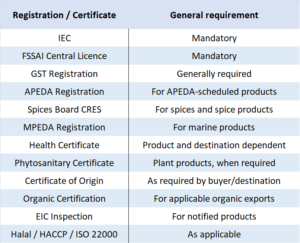
- Quick Checklist: Which Registrations Does a Food Exporter Need?
Here is a simplified checklist for a new Indian food exporter.
Conclusion
Exporting food products from India requires proper planning, registrations and compliance with food safety and international trade regulations. While IEC and FSSAI licensing are important starting points, additional registrations such as APEDA, Spices Board, MPEDA and EIC certification depend on the product being exported.
A merchant exporter and a manufacturer exporter may also have different compliance responsibilities.
Before starting your food export business, identify your product’s HS Code, check whether it is freely exportable or restricted, identify the relevant government authority and understand the importing country’s food safety requirements.
Remember, having the right licenses and certificates not only helps prevent shipment delays and rejection but also builds confidence among international buyers.
Frequently Asked Questions (FAQs)
- Is FSSAI license mandatory for exporting food products from India?
Yes. Food exporters must obtain the applicable FSSAI license. Exporters are eligible for a Central FSSAI License under the Merchant-Exporter category. A separate FSSAI NOC for exporting is not required.
- Is APEDA registration compulsory for all food exporters?
No. APEDA registration is required for exporters dealing in APEDA-scheduled products, such as fruits, vegetables, meat, dairy, cereals, basmati rice and other notified products. Other food exporters may need registration with their respective Commodity Boards.
- Can a merchant exporter export food products without owning a manufacturing unit?
Yes. A merchant exporter can source food products from eligible manufacturers or processing units and export them, subject to applicable FSSAI licensing, establishment approval, product-specific registration and traceability requirements.
- Is a Health Certificate compulsory for exporting all food products from India?
No. A Health Certificate is required only for products and destinations where the importing country’s regulations or applicable Indian export requirements prescribe it. Seafood and meat exports have specific inspection and certification requirements.
- Can I export food products from India without a Phytosanitary Certificate?
Yes, where the importing country’s plant quarantine regulations do not require one. For regulated plants and plant products, the certificate may be compulsory to confirm compliance with the destination country’s pest-control requirements.