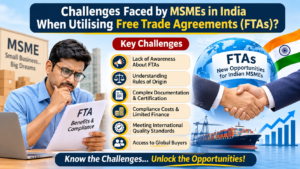
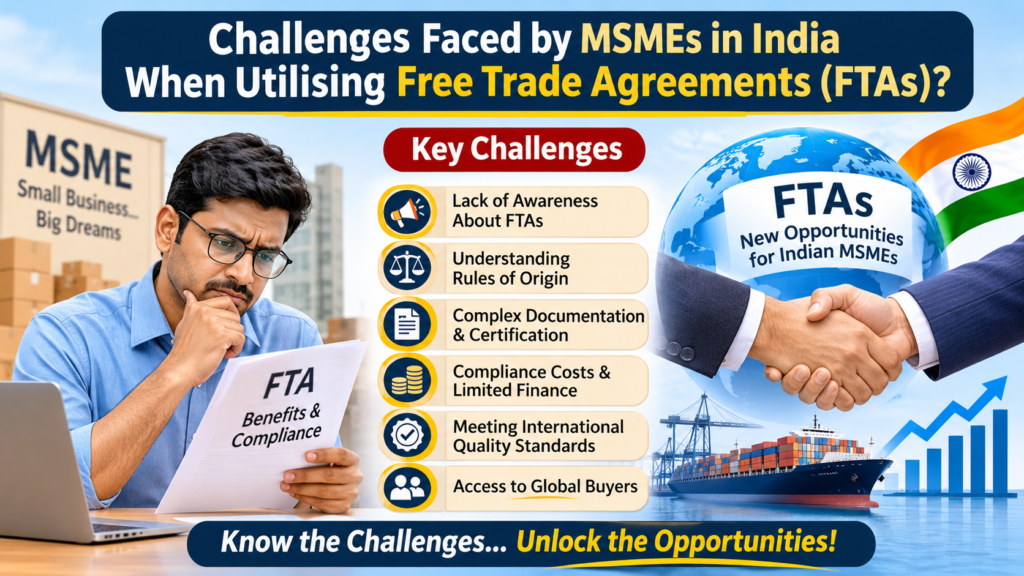
What Are the Challenges Faced by MSMEs in India When Utilizing Free Trade Agreements (FTAs)?
Free Trade Agreements (FTAs) offer Indian businesses an excellent opportunity to expand into international markets by reducing or eliminating customs duties, improving market access and encouraging international trade.
For Micro, Small and Medium Enterprises (MSMEs) in India, FTAs can create new opportunities to export products at competitive prices and connect with global buyers. However, despite these benefits, many Indian MSMEs are unable to take full advantage of the trade opportunities offered by FTAs.
Lack of awareness, complicated documentation, Rules of Origin, quality standards, certification requirements and limited financial resources are some of the major challenges.
Understanding these Free Trade Agreement challenges for Indian MSMEs is important for businesses that want to improve their export competitiveness and benefit from India’s growing network of international trade agreements.
Major Challenges Faced by Indian MSMEs in Utilizing FTAs
1. Lack of Awareness About FTAs
Many MSME exporters are unaware of the FTAs signed by India and the benefits available for their products in different countries.
They may not know:
- Which countries have trade agreements with India.
- Whether their products are covered under an FTA.
- What preferential customs duty is available.
- How to claim the benefits of an FTA.
As a result, many businesses continue exporting without exploring available duty concessions.
2. Difficulty in Understanding Rules of Origin (RoO)
Rules of Origin determine whether a product qualifies as originating from India and is eligible for preferential customs duty under an FTA.
MSMEs often find it difficult to understand:
- Local value addition requirements.
- Change in tariff classification.
- Product-specific Rules of Origin.
- Requirements for imported raw materials and components.
If an exporter fails to meet the applicable Rules of Origin, the overseas buyer may not receive the expected customs duty benefit.
3. Complicated Documentation and Certification
To claim preferential duty benefits, exporters must comply with the documentation requirements of the relevant FTA.
These may include:
- Certificate of Origin (preferential).
- Commercial Invoice and Packing List.
- Shipping and transport documents.
- Supporting documents for value addition and manufacturing processes.
The procedures can be confusing for small exporters who do not have dedicated export documentation teams.
4. High Cost of Compliance and Certification
International markets often require products to meet specific quality, safety, technical and environmental standards.
Depending on the product and destination country, MSMEs may need testing, inspection, laboratory reports and product certifications.
These compliance costs can be particularly difficult for smaller businesses with limited financial resources.
5. Limited Financial Resources
Even when an FTA provides lower customs duties, exporters must still invest in production, packaging, quality control, logistics, certifications and marketing.
Many MSMEs face difficulties in arranging working capital and financing these additional expenses.
Limited access to affordable finance can prevent them from exploring new international markets.
6. Difficulty in Meeting International Quality Standards
FTAs may improve market access, but they do not automatically reduce the quality and safety requirements of importing countries.
MSMEs may struggle to meet:
- International product quality standards.
- Technical regulations.
- Packaging and labelling requirements.
- Food safety and sanitary and phytosanitary (SPS) measures, wherever applicable.
- Environmental and sustainability requirements.
Failure to meet these standards can result in shipment rejection, delays or additional costs.
7. Lack of Skilled Professionals and Technical Knowledge
Many MSMEs do not have specialized professionals to handle international trade documentation, customs procedures, tariff classification and FTA compliance.
Understanding tariff schedules, HS codes, Rules of Origin and preferential duty calculations requires technical knowledge.
This knowledge gap often discourages smaller businesses from using FTA benefits.
8. Limited Access to International Buyers
An FTA can provide preferential market access, but it does not guarantee overseas customers.
MSMEs still need to identify genuine buyers, understand market demand, compete with international suppliers and build trust with foreign customers.
Lack of international marketing networks and buyer connections remains a major challenge.
9. Competition from Other Countries
FTAs can also increase competition in the Indian domestic market by allowing goods from partner countries to enter at reduced customs duties.
Indian MSMEs may face competition from foreign manufacturers that have better technology, larger production capacities, lower costs or stronger supply chains.
Therefore, improving productivity, quality and pricing is essential.
10. Difficulty in Calculating the Actual FTA Benefit
A reduction in customs duty does not always mean that the product becomes cheaper or more competitive.
Exporters and importers must consider:
- Applicable preferential customs duty.
- Rules of Origin compliance costs.
- Certification and documentation expenses.
- Freight and insurance.
- Other applicable import charges.
MSMEs need to calculate the actual landed-cost advantage before deciding whether to use an FTA.
How Can Indian MSMEs Overcome These Challenges?
Indian MSMEs can improve their utilization of Free Trade Agreements by taking a few practical steps:
- Identify suitable FTAs: Study India’s trade agreements and identify markets where their products receive preferential tariff benefits.
- Check HS Codes and Tariff Benefits: Verify the correct HS classification and applicable preferential customs duty in the importing country.
- Understand Rules of Origin: Check product-specific origin criteria before accepting an export order.
- Obtain the Required Certificate of Origin: Understand the applicable issuing authority and documentation process.
- Meet International Standards: Invest in quality control, testing and product certifications required by the destination market.
- Seek Professional Guidance: Consult export promotion councils, industry associations, trade experts and customs professionals.
- Build International Buyer Networks: Participate in trade fairs, B2B meetings and international business networking programmes.
- Calculate Export Profitability: Compare the actual duty savings with the additional costs of FTA compliance.
Conclusion
Free Trade Agreements provide Indian MSMEs with significant opportunities to enter new international markets, reduce customs duties and improve export competitiveness. However, the benefits of FTAs can only be realised when businesses understand the agreement and fulfil its requirements.
Lack of awareness, complicated Rules of Origin, documentation, certification costs, financial limitations and international quality standards continue to restrict FTA utilization among smaller businesses.
Indian MSMEs must therefore move beyond simply knowing that an FTA exists. They should understand how to identify applicable tariff benefits, fulfil origin requirements and use preferential trade provisions effectively.
An FTA is not just a trade agreement; it is an opportunity for Indian MSMEs to become globally competitive. The real benefit lies in knowing how to use it.
Frequently Asked Questions (FAQs)
1. What are the major challenges faced by Indian MSMEs in using FTAs?
The major challenges include lack of awareness, complicated Rules of Origin, documentation requirements, certification costs, limited finance, international quality standards and difficulty in finding overseas buyers.
2. Do all Indian MSME exporters automatically receive FTA benefits?
No. An exporter must ensure that the product is covered under the relevant FTA, satisfies the applicable Rules of Origin and meets the required documentation and certification conditions.
3. What is the importance of Rules of Origin in an FTA?
Rules of Origin establish the country of origin of a product. They determine whether goods qualify for preferential customs duty under a particular trade agreement.
4. How can an Indian MSME check whether its product qualifies for FTA benefits?
An MSME should identify its correct HS Code, check the relevant FTA tariff schedule, examine product-specific Rules of Origin and verify the applicable preferential duty and documentation requirements.
5. Where can Indian MSMEs get assistance in understanding FTA benefits?
MSMEs can approach the Directorate General of Foreign Trade (DGFT), Export Promotion Councils, Federation of Indian Export Organizations (FIEO), industry associations and professional export-import consultants for guidance.