Export Certification Explained: Types, Importance and When Indian Exporters Need It
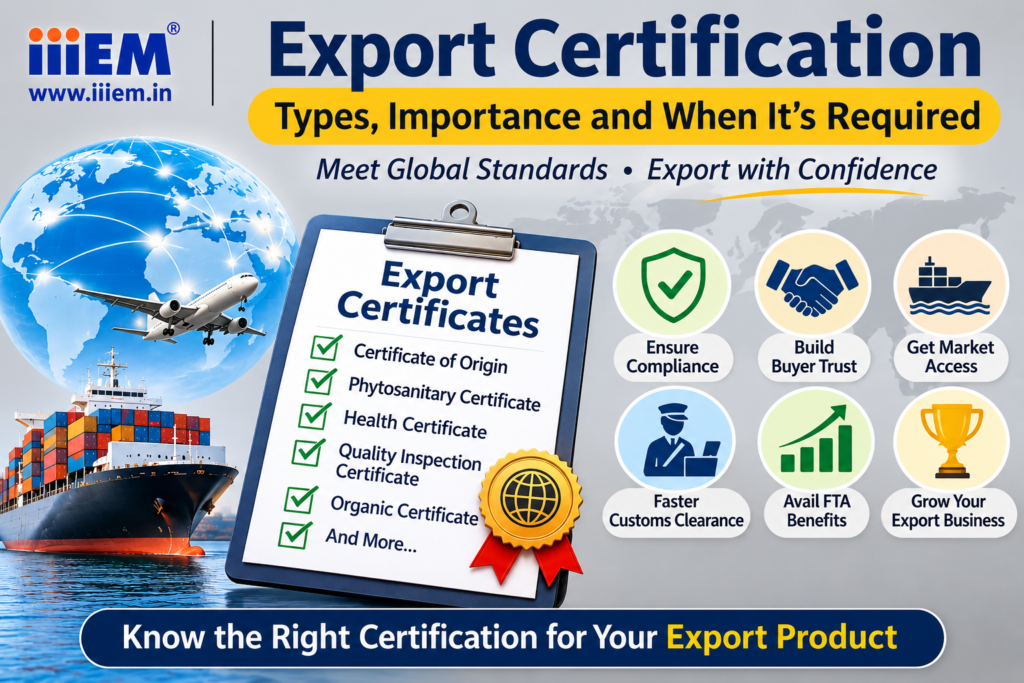
Have you ever wondered why an overseas buyer asks for a Certificate of Origin, Phytosanitary Certificate, Health Certificate or Quality Inspection Certificate before accepting your goods?
These are examples of export certificates that help establish the origin, quality, safety and compliance of products entering international markets.
Export Certification is an important part of international trade. It helps Indian exporters meet government regulations, importing country requirements and buyer expectations. But does every export product require certification? Who issues these certificates, and when should an exporter obtain them?
Let’s understand the basics.
-
What is Export Certification?
Export Certification is the process of obtaining an official certificate, approval or verification from an authorised government agency, recognised certification body or testing organisation to confirm that an exported product meets specified requirements.
Depending on the product and destination country, certification may confirm:
- Country of origin of the product.
- Quality and safety of the product.
- Compliance with technical standards.
- Food safety and hygiene.
- Plant and animal health requirements.
- Organic production standards.
- Product testing and inspection.
There is no single universal export certificate applicable to all products. The certificates required depend on the product, HS Code and importing country’s regulations.
-
When is Export Certification Required?
Export certification may be required in the following situations:
- Government Regulations: When India or the importing country makes a particular certificate mandatory for a product.
- Product Safety: When the product needs to meet specific food safety, health, chemical or technical standards.
- International Trade Agreements: When an exporter wants to claim preferential customs duty benefits under a Free Trade Agreement (FTA), a qualifying Certificate of Origin may be required.
- Buyer Requirements: When an overseas buyer requests certificates to verify product quality, origin, testing or manufacturing standards.
- Market Entry Requirements: When the importing country requires product registration, inspection or certification before allowing the goods into its market
3. Important Types of Export Certificates and Their Uses
Here are some commonly used export certificates and their applications:
|
Certificate |
Purpose | Products / Industries |
|
Certificate of Origin (CoO) |
Confirms the country of origin of goods | All types of products |
| Phytosanitary Certificate | Confirms compliance with plant health requirements | Fruits, vegetables, seeds, plants |
| Health Certificate | Confirms applicable health and safety requirements |
Meat, fish, dairy and food products |
|
Quality Inspection Certificate |
Confirms product quality and specifications | Engineering, chemicals and notified commodities |
| Fumigation Certificate | Confirms fumigation treatment where required | Agricultural products, wooden packaging |
| Organic Certificate | Confirms compliance with applicable organic standards |
Organic food, spices, agricultural products |
|
Certificate of Analysis (CoA) |
Provides laboratory test results and product composition | Chemicals, pharmaceuticals, food ingredients |
| Free Sale Certificate | Confirms that a product is permitted for sale in its country of origin, where applicable |
Cosmetics, healthcare and certain regulated products |
| Conformity Certificate | Confirms compliance with applicable technical standards |
Electronics, machinery and consumer goods |
Note: Not all these certificates are mandatory for every shipment. Requirements vary by destination country and product.
-
Who Issues Export Certificates in India?
Different certificates are issued by different authorities and recognised organisations.
|
Authority / Organisation |
Relevant Certification |
|
DGFT / Designated Issuing Agencies |
Certificate of Origin |
|
Export Inspection Council (EIC) |
Export inspection, quality and health certification for notified products |
| APEDA / Accredited Certification Bodies |
Organic certification under applicable NPOP requirements |
|
Plant Quarantine Authorities (DPPQ&S) |
Phytosanitary Certificate |
| MPEDA / Relevant Authorities |
Marine product export-related approvals and certifications |
|
NABL-Accredited Laboratories |
Testing and laboratory reports within their accredited scope |
| BIS / Authorised Certification Bodies |
Product conformity and applicable quality certification |
The issuing authority depends on the certificate and the applicable regulations.
-
How Can a New Exporter Obtain the Required Certificates?
Follow these steps before shipping your first export consignment:
- Identify Your Product: Find the correct HS Code and product description.
- Identify Your Destination Country: Requirements may differ between countries, even for the same product.
- Check Mandatory Requirements: Refer to DGFT, the relevant Export Promotion Council and the importing country’s official regulatory authorities.
- Confirm Buyer Requirements: Ask your overseas buyer for the list of certificates, testing reports and product standards required.
- Approach the Correct Authority: Apply to the government department, certification body or authorised agency responsible for issuing the certificate.
- Complete Testing or Inspection: Arrange product testing, factory inspection or consignment inspection wherever required.
- Obtain the Certificate: Keep the original or digitally issued certificate ready for submission to your buyer, customs or importing country authorities, as applicable.
- Why is Export Certification Important?
Export certification is not just paperwork. It plays an important role in building a successful export business.
- Market Access: Helps exporters meet regulatory requirements of international markets.
- Buyer Confidence: Builds trust by providing evidence of product quality, origin and safety.
- Customs Clearance: Helps avoid delays caused by missing mandatory certificates.
- FTA Benefits: A valid Preferential Certificate of Origin can help eligible products receive reduced customs duties.
- Product Acceptance: Reduces the risk of shipment rejection due to non-compliance.
- Business Reputation: Strengthens the credibility of Indian exporters in the global marketplace.
Conclusion
Export certification is an essential part of understanding export compliance and international trade regulations. However, new exporters must remember that every product does not require every certificate.
Before accepting an export order, identify the correct HS Code, check the importing country’s regulations and confirm the buyer’s certification requirements.
The right certification, obtained from the right authority at the right time, can help Indian exporters reduce risks, gain buyer confidence and access international markets successfully.
Remember: Exporting is not just about selling products globally; it is also about meeting global standards!
Frequently Asked Questions (FAQs)
- Is export certification mandatory for all products in India?
No. Export certification is mandatory only for products and situations where Indian regulations or importing country requirements prescribe it. Buyers may also request additional voluntary certifications.
- Who issues export certificates in India?
Different authorities issue different certificates. DGFT and designated agencies facilitate Certificates of Origin, EIC handles notified export inspection and certification, and DPPQ&S issues Phytosanitary Certificates.
- What is the difference between a Certificate of Origin and a Quality Certificate?
A Certificate of Origin confirms where the goods originate, whereas a Quality Certificate provides assurance or evidence that the product meets specified quality requirements.
- Can a merchant exporter obtain export certification?
Yes. Merchant exporters can obtain applicable export certificates, subject to the product-specific requirements. Some certifications may also require an approved manufacturing or processing facility.
- How can I check which export certificates my product requires?
Check your HS Code, DGFT export policy, the importing country’s regulations, relevant Export Promotion Council guidelines and buyer requirements before ship