When you receive your first export order, you may come across two important terms in shipping and logistics: ICD (Inland Container Depot) and CFS (Container Freight Station).
Both facilities play an important role in India’s export-import trade. They help exporters handle cargo, containers and customs-related activities before goods move towards the seaport for international shipment.
But what is the difference between ICD and CFS? When should an exporter use an ICD, and when is a CFS a better option? Most importantly, which one is more suitable for a merchant exporter?
Let’s understand these terms in simple language.
- What is an ICD (Inland Container Depot)?
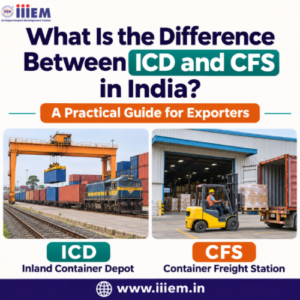
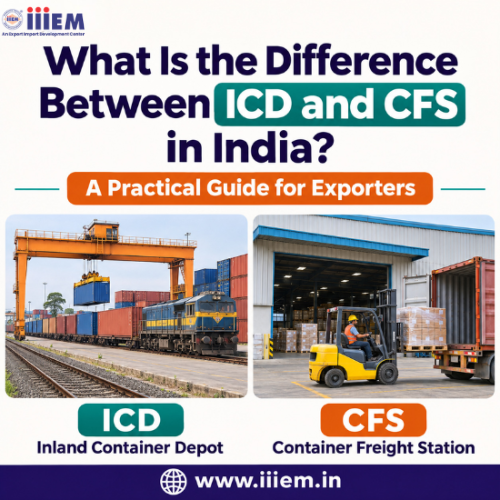
An Inland Container Depot, commonly called an ICD or dry port, is an inland facility where export and import containers can be handled and customs-related activities can be carried out.
It connects inland manufacturing and trading centres with seaports through road, rail or other transport networks.
At an ICD, exporters may be able to:
- Bring export cargo for customs examination and clearance.
- Stuff goods into containers.
- Complete container sealing and documentation formalities.
- Handle full container load (FCL) shipments.
- Arrange onward movement of containers to the gateway seaport.
Example: An exporter in Ahmedabad may use an ICD in the region to handle export cargo rather than sending the goods directly to a distant seaport. The container can then move towards the gateway port through the available transport network.
- What is a CFS (Container Freight Station)?
A Container Freight Station, commonly called a CFS, is a facility generally located near a seaport. It is used for handling, storing, consolidating and deconsolidating cargo and containers.
A CFS is particularly useful when cargo needs to be grouped with other shipments or separated after arrival.
At a CFS, exporters may be able to:
- Receive export cargo.
- Consolidate goods from different exporters into one container.
- Stuff cargo into containers.
- Arrange customs examination and clearance.
- Store cargo temporarily before shipment.
- Complete container handling and related documentation activities.
Example: A merchant exporter shipping a small quantity of goods may send the cargo to a CFS near the port. The cargo can be consolidated with shipments from other exporters and moved in a shared container.
- Difference between ICD and CFS
| Particulars | ICD | CFS |
| Full form | Inland Container Depot | Container Freight Station |
| Location | Inland, away from the seaport | Generally near or around a seaport |
| Main purpose | Inland container handling and customs-related clearance | Cargo handling, consolidation, deconsolidation and container operations |
| Connectivity | Usually connected to ports by road or rail; facilities vary | Primarily connected to the nearby seaport by road |
| Customs facilities | Customs clearance facilities are available | Customs-related clearance and examination facilities are available as authorised |
| FCL shipments | Suitable | Suitable |
| LCL shipments | Depends on available services | Particularly useful for consolidation of LCL cargo |
| Container movement | Containers move from the ICD to the gateway port | Containers move between the CFS and the nearby port |
| Best suited for | Exporters located in inland production and trading centres | Exporters requiring port-side cargo handling and consolidation |
Note: The exact services available depend on the facility’s customs approval, infrastructure and shipping-line arrangements.
- When Should a Merchant Exporter Use an ICD?
An ICD may be a better choice when:
- Your manufacturing unit or supplier is located far from the seaport.
- You want to reduce the cost of moving loose cargo over a long road journey to the port.
- You are shipping a full container load (FCL).
- The ICD offers suitable rail or road connectivity to your destination port.
- Customs clearance and container handling can conveniently be completed at the inland facility.
For example, an exporter based in Ahmedabad may compare an available ICD with direct transportation to Mundra or Nhava Sheva. The decision should be based on the total logistics cost and transit time.
- When Should a Merchant Exporter Use a CFS?
A CFS may be more suitable when:
- Your cargo needs to be consolidated with shipments from other exporters.
- You are shipping a less than container load (LCL).
- Your cargo is already close to the seaport.
- You need temporary cargo storage, examination or container stuffing near the port.
- Your freight forwarder or shipping line has recommended a particular CFS for the shipment.
For small merchant exporters who do not have enough goods to fill an entire container, a CFS can be particularly useful for LCL shipments.
- ICD or CFS: Which Is Better for a Merchant Exporter?
There is no single answer. Both facilities can be useful, depending on the shipment and the exporter’s location.
| Merchant Exporter’s Situation | Suggested Option |
| Exporter located in an inland city | Compare nearby ICD options |
| Exporter shipping small quantities (LCL) | CFS offering consolidation services |
| Exporter shipping a full container (FCL) | Compare ICD, CFS and direct port movement |
| Exporter located near a seaport | CFS or direct port movement |
| Exporter looking to reduce inland transportation costs | Compare ICD connectivity and total movement cost |
Before choosing, compare the complete cost, including cargo transportation, handling, stuffing, customs examination, storage, documentation, terminal charges and movement to the seaport.
Also check the expected transit time, cut-off dates, shipping-line acceptance and availability of services.
- Important Tips for New Merchant Exporters
Before finalizing an ICD or CFS, remember these points:
- Consult your freight forwarder: Ask which ICD or CFS is suitable for your destination port and shipping line.
- Compare total costs: Do not select a facility only because its handling charges are lower.
- Check transit time: Ensure that cargo reaches the seaport before the vessel’s cut-off date.
- Understand LCL and FCL: Your shipment size plays an important role in choosing the facility.
- Check customs and handling facilities: Confirm that the selected facility is authorised and can handle your type of cargo.
Conclusion
ICD and CFS facilities are important parts of India’s export logistics network. While an ICD provides an inland connection to seaports and supports container handling and customs clearance, a CFS mainly supports cargo handling, consolidation and container operations, generally near a seaport.
For a merchant exporter, the best choice is not necessarily the nearest facility or the one with the lowest handling charge. It is the facility that offers the right combination of cost, convenience, customs services and timely movement of goods.
Remember: Choose your ICD or CFS based on your cargo volume, location, shipping route and total logistics cost. A well-planned logistics decision can help you save money and deliver your export shipment on time.
Frequently Asked Questions (FAQs)
- What is the main difference between ICD and CFS?
An ICD is an inland container facility connected to seaports through transport networks. A CFS is generally located near a seaport and supports cargo handling, consolidation, and deconsolidation and container operations.
- Can a merchant exporter use an ICD for export shipments?
Yes. Merchant exporters can use an authorised ICD for export cargo handling and customs-related clearance, subject to the facility’s services and shipping arrangements.
- Is CFS better for LCL shipments?
A CFS is often suitable for LCL shipments because it can consolidate cargo from multiple exporters into one container. The exporter should check the availability and cost of the consolidation service.
- Can export customs clearance be done at an ICD or CFS?
Yes. Customs clearance and examination can be carried out at authorised ICDs and CFSs, subject to their approved facilities and applicable customs procedures.
- Which is cheaper: ICD or CFS?
Neither is always cheaper. The total cost depends on the exporter’s location, cargo quantity, and transportation distance, handling charges, storage, container movement and shipping-line arrangements.