Introduction
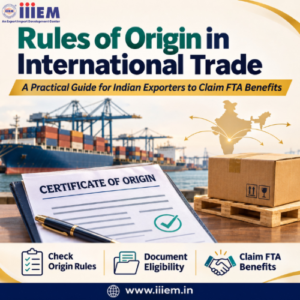
Rules of origin are the foundation of preferential trade. For Indian exporters, they determine whether goods shipped under a Free Trade Agreement (FTA), Preferential Trade Agreement (PTA), or unilateral concession can receive lower import duties in the destination market. Under India’s FTAs, PTAs, and GSP schemes, tariff concessions are available only when the prescribed rules of origin are met.
In simple terms, rules of origin establish whether a product is genuinely “Indian” for trade purposes. This matters because a product may be assembled in India but contain imported raw materials, components, or intermediates. If the product does not meet the applicable origin criteria, the importer may lose the preferential tariff benefit—even if the shipment otherwise has a certificate of origin.
What Are Rules of Origin?
Rules of origin are legal criteria used to determine the country of origin of a good for export or import purposes. They help customs authorities decide whether a product qualifies as originating in India and is therefore eligible for preferential treatment under a specific trade agreement.
For Indian exporters, the applicable rules depend on the destination country and the trade agreement involved. The same product may qualify under one FTA but not another because each agreement can have different product-specific rules, documentation requirements, and verification procedures.
For an overview of India’s bilateral agreements and their names, see our guide to India’s bilateral trade agreements
Main Origin Criteria
-
Wholly obtained products
A product may qualify as originating if it is wholly obtained or produced in India. Examples include minerals extracted in India, agricultural produce grown in India, and fish caught by Indian vessels, subject to the agreement’s conditions.
-
Substantial transformation
Most manufactured products are not wholly Indian because they use imported inputs. In such cases, the product must undergo sufficient processing or manufacturing in India to become “originating.” This is commonly assessed through a change in tariff classification, specific manufacturing processes, or a minimum value-addition requirement.
-
Value addition requirement
Value addition measures how much value is created in India. A typical build-down formula is:
For example, if an FTA requires 35 per cent value addition, an exporter must demonstrate that at least 35 per cent of the product’s value is created in India under the agreement’s calculation method.
-
Change in tariff classification
Some agreements require a Change in Tariff Classification (CTC). This means the final product must move to a different HS-code heading or subheading from the non-originating inputs used in its production. Correct HS classification is therefore essential for FTA eligibility.
Certificate of Origin for Indian Exporters
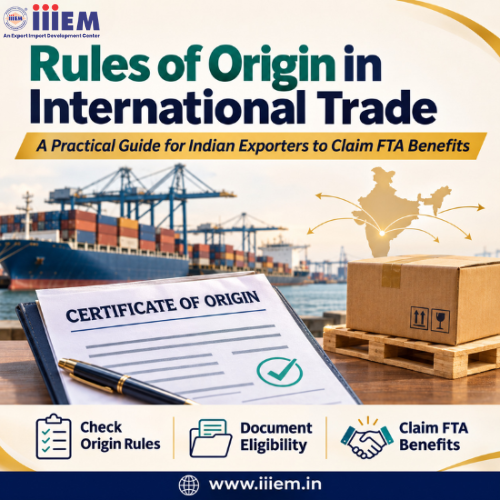
A Certificate of Origin (CoO) is documentary evidence that goods meet the origin requirements of a particular trade agreement. It contains product details, HS classification, origin criterion, exporter and importer information, and certification by the authorised issuing body.
India has enabled a common digital platform for paperless issuance of certificates of origin for all FTAs and PTAs, across agencies and products. Exporters using self-declaration under certain agreements must register and issue self-certified CoOs through DGFT’s Common Digital Platform.
To obtain a CoO, exporters generally need to submit an application, supporting evidence of origin, the commercial invoice, and other documents establishing that the product meets the applicable origin rule.
Why Compliance Matters
Incorrect origin claims can lead to denial of tariff benefits, customs scrutiny, penalties, delayed shipments, and loss of buyer confidence. Importing-country customs authorities may verify origin claims through documents, factory information, supplier declarations, and audits.
Indian exporters should maintain a complete origin file for every product and shipment. This should include bills of materials, supplier declarations, purchase invoices, production records, cost sheets, HS-code classification, test reports where relevant, and the applicable FTA rule. Accurate documentation is especially important for products with imported components, such as electronics, garments, machinery, chemicals, and auto parts.
How Indian Exporters Can Prepare
- Identify the correct trade agreement and confirm whether the destination country offers a tariff preference for the product.
- Check the product-specific rule of origin, including value addition, CTC, or process requirements.
- Classify the product under the correct HS code and review the classification of key inputs.
- Collect supplier declarations and traceability records for imported materials.
- Calculate value addition using the method prescribed in the agreement.
- Apply for the appropriate certificate of origin through the authorized
- What are rules of origin? How do Indian exporters claim FTA benefits? What is a certificate of origin? What is value addition under rules of origin? How can Indian exporters avoid rules-of-origin errors?
- channel.
- Retain records for the period required under the agreement and be prepared for verification.
before the paragraph beginning “For MSMEs…”If you are preparing your first shipment, see iiiEM’s guide to the export process from India for the broader steps from product classification to shipment.
For MSMEs, working with a customs broker, export consultant, or FTA desk can reduce costly errors. However, the exporter remains responsible for the accuracy of origin declarations and supporting evidence.
Conclusion
Rules of origin are not merely paperwork; they decide whether Indian exporters can convert trade agreements into real cost advantages. A product that meets the applicable origin rule can enter partner markets at lower duties, improving competitiveness and margins. Conversely, an incorrect claim can result in lost benefits and compliance risk.
As India expands its trade-agreement network, exporters should build strong internal systems for HS classification, supplier documentation, value-addition calculation, and certificate-of-origin management. Export-ready compliance will help Indian businesses use FTAs confidently and compete more effectively in global markets.
Frequently Asked Questions (FAQs)
1. What are rules of origin in international trade?
Rules of origin are criteria that determine the country in which a product is considered to originate. They decide whether goods qualify for preferential tariffs under an FTA, PTA, or other trade concession.
2. Why do Indian exporters need a certificate of origin?
A certificate of origin proves that exported goods meet the origin requirements of the relevant trade agreement. It supports the importer’s claim for preferential tariff treatment in the destination country.
3. What is value addition under rules of origin?
Value addition is the proportion of value created in the exporting country. Many FTAs require a minimum percentage of local value addition before a product can be treated as originating.
4. Can a product made in India with imported materials qualify for FTA benefits?
Yes, if it undergoes sufficient processing in India and meets the agreement’s product-specific rule, such as value addition, change in tariff classification, or a specified manufacturing process.
5. Where can Indian exporters apply for a certificate of origin?
Indian exporters can apply through the DGFT-enabled Common Digital Platform for issuance of certificates of origin, which supports paperless certification for FTAs and PTAs.